

Sunday’s Reflection—The Word
December 28, 2025

John 1:1-18
        In the beginning was the Word, and the Word was with God, and the Word was God. He was in the beginning with God. All things came into being through him, and without him not one thing came into being. What has come into being in him was life, and the life was the light of all people. The light shines in the darkness, and the darkness did not overcome it.

        There was a man sent from God, whose name was John. He came as a witness to testify to the light, so that all might believe through him. He himself was not the light, but he came to testify to the light. The true light, which enlightens everyone, was coming into the world.

         He was in the world, and the world came into being through him; yet the world did not know him. He came to what was his own, and his own people did not accept him. But to all who received him, who believed in his name, he gave power to become children of God, who were born, not of blood or of the will of the flesh or of the will of man, but of God.

        And the Word became flesh and lived among us, and we have seen his glory, the glory as of a father’s only son, full of grace and truth. (John testified to him and cried out, “This was he of whom I said, ‘He who comes after me ranks ahead of me because he was before me.’”) From his fullness we have all received, grace upon grace. The law indeed was given through Moses; grace and truth came through Jesus Christ. No one has ever seen God. It is God the only Son, who is close to the Father’s heart, who has made him known.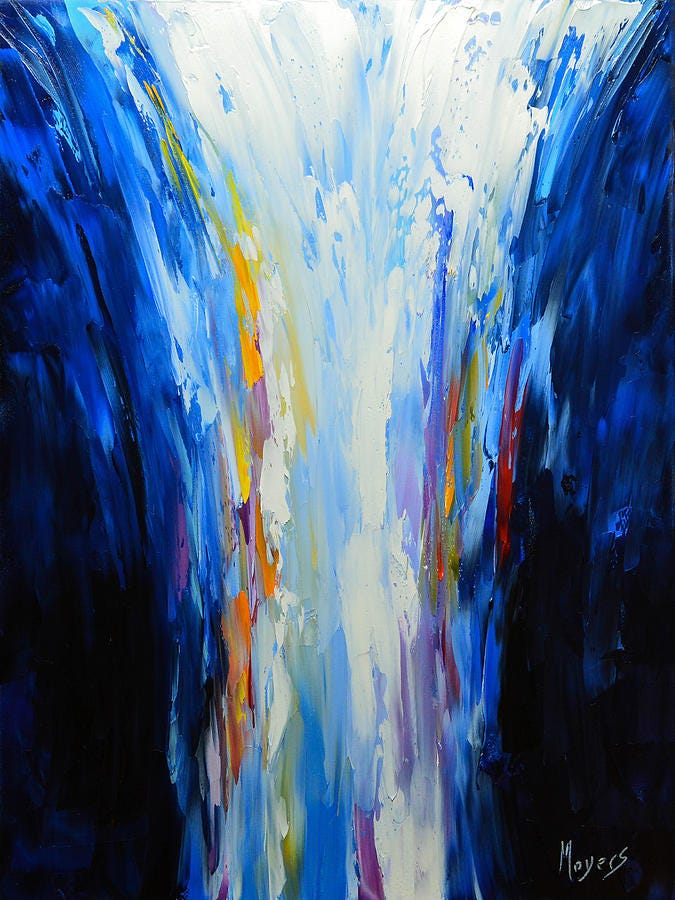
“The Word Made Flesh, God Poured Out”, by Mike Moyers
         Several years ago, I visited my friend Rabbi Rick Winer, who was then the Rabbi at Congregation Beth Emek in Pleasanton, California. This large synagogue is modern, built in the Arts and Crafts style, with beautiful stained glass windows filled with red pomegranates. Behind the altar stands a large twelve-foot-high Ark of the Torah. It is a fancy Tabernacle which contains several Torah scrolls of the first five books of the Old Testament. Some of these Torah scrolls are over 300 years old, many of which were rescued by Jewish families fleeing from the Holocaust.

	 The doors to the Ark of the Torah are made of clear glass adorned with red pomegranates, green leaves, and random Hebrew letters. When Rabbi Rick opened the doors, to my delight, I saw that the Ark’s interior domed ceiling was painted sky blue with dozens of painted letters from the Hebrew alphabet tumbling out of the blue sky, proceeding from the mouth of God, which was painted in the form of a cloud.
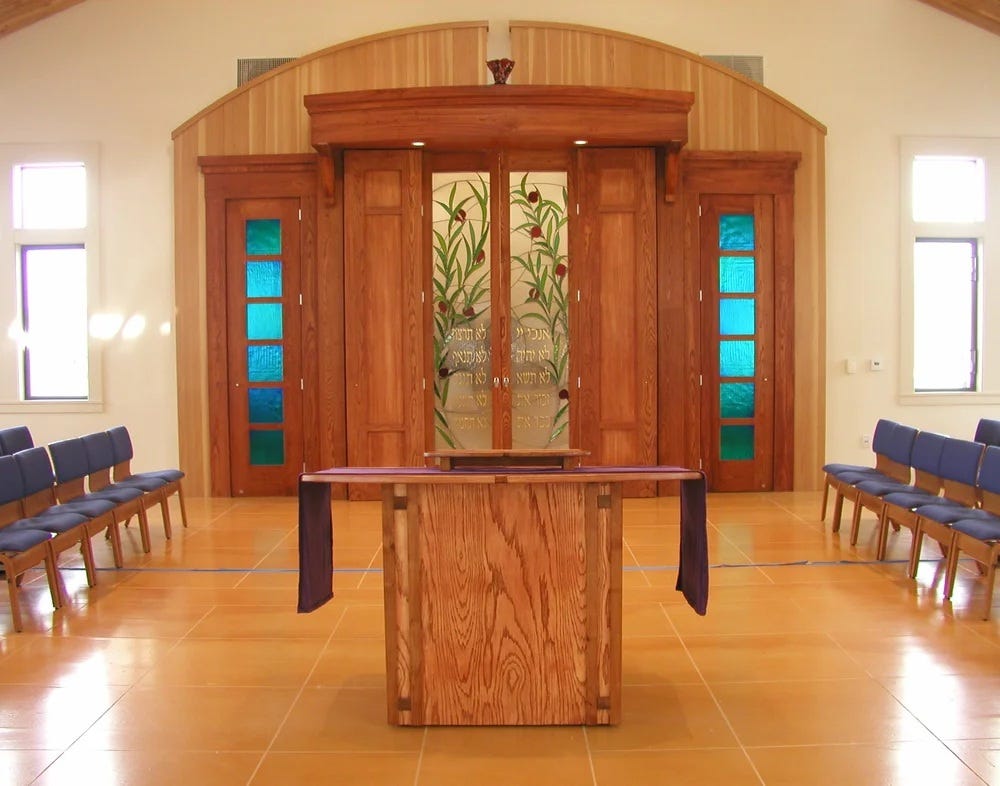
                 The Tabernacle of Congregation Beth Emek, Pleasanton, California
              The glass doors were designed and built by Plachte-Zuieback Art Glass.
         This image of letters falling from God originates from a 2nd-century book of Jewish mysticism known as the Sefer Yetsirah (The Book of Creation). According to this Book of Creation, God created the universe using thirty-two mysterious paths consisting of twenty-two letters of the Hebrew alphabet together with ten sefirot, which are the ten primordial numbers associated with the attributes of God.

	The Sefer Yetsirah asserts that with these twenty-two letters, by giving them a form and shape, and by mixing them and combining them in different ways, God made the soul of all that has been created and all of that which will be. It is upon these same letters that the Holy One (blessed be He) has founded His high and holy name.

	I believe that letters and words are important. I love words, how they sound in the mouth, on the lips, and in the ear. I love what they mean, and the power they invoke. I love how words can sound the same but evoke totally different moods and meanings, like gloom and bloom, and dusk and brusk. I love words like dappled, whirl, whisk, shrink, sluice, burst, finch, swallow, chestnut, thatch, freshen, dazzle, and twilight. And fun words like gargoyle, rumpus, bumfuzzle, and shenanigans.

	As I was writing this reflection, I typed the word manger and was startled when Spellcheck corrected me, suggesting the word manager instead. Since a manager is about the farthest thing from a manger, I quickly added the word manger to my Spellcheck dictionary.

	Today’s Gospel writes about the Word. Not just any word, but the Word itself.  John says: And the Word became flesh and lived among us. Jesus is the living Word uttered by the mouth of God. And this was not simply a theoretical, past event, but the Word is being uttered every day.

	Madeleine L’Engle once wrote, “In the mystery of the Word made Flesh the Maker of the stars was born.” This is a huge mystery.

“The Blue Madonna: And the Word Became Flesh”, Frank, Wesley, 1923-2002
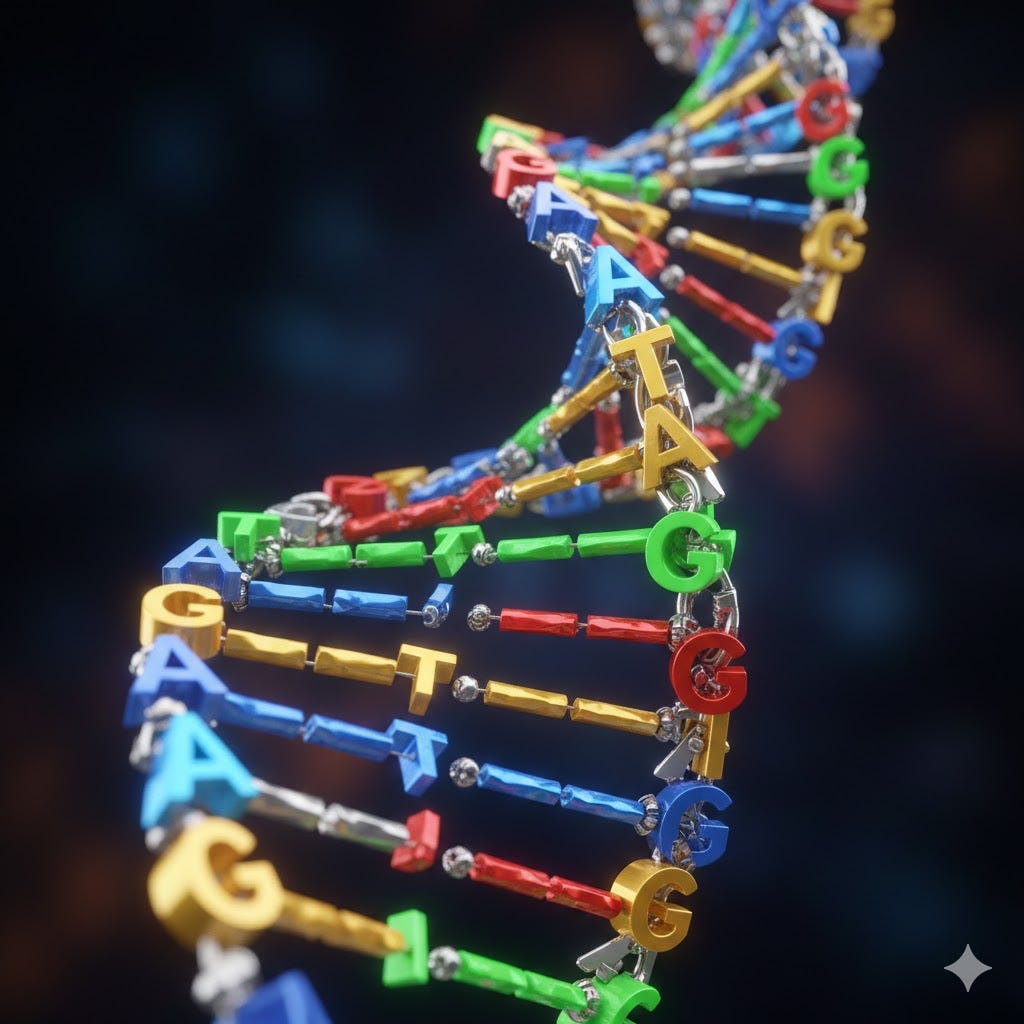
If we read John rightly, the Incarnation is a threefold process. First, there is the word Word, which in Greek is the word Logos. The Logos is a rich word that means the universal, divine, ordering principle of the cosmos, that embodies reason, wisdom, and is the rational structure of reality. The Logos is like DNA, made up of a helix of letters which forms the blueprint or fundamental pattern for all existence.

In the Beginning was the Word, by Nadene EsterhuizenSecondly, the Word became flesh. In Greek, the word for “flesh” is sarx, which is the human body (male and female) in its entirety—a human being. God did not want to relate to us in the abstract but in the flesh, and by doing so, has made all human flesh—all people holy. This means that the people who: launder your clothes at the dry cleaners in back rooms, short order cooks, truck drivers, beauticians, nurses, dentists, ditch diggers, card sharks, prostitutes, teachers, people of all faiths, and baseball players all have the same spark of holiness in them. But because of our scientific understanding of evolution and how life forms evolved throughout history, homo sapiens, human beings, cannot be separated from the rest of creation. We are all part of the same cloth, the same biology. Scientists call this LUCA—the last universal common cellular ancestor from which all life forms descend.
         The Incarnation makes humans, plus all creatures, all living flesh, holy. This means that earthworms, mosquitoes, rattlesnakes, butterflies, kittens and puppies, shrimp, wild horses, elephants, anteaters, tigers, penguins, whales, clams, dolphins, and even scorpions and skunks are holy.

	Third, John says, “the Word became flesh and lived among us.” The word in Greek for “lived” is eskēnōsen, to dwell or abide, but it has a deeper meaning taken from the root form skenoo. Skenoo in classical Greek means “to pitch tents, encamp, dwell in a tent, settle, take up residence.”  When Israel wandered for forty years in the wilderness, the dwelling place of God was a simple tent, the Tabernacle, the Mishkan (Hebrew), which was pitched, packed, and unpacked numerous times wherever they went.

	Unlike the Temple, built first by Solomon, the Tabernacle symbolized the portable character of Israel’s national life and the mobility of God who went with His people and tented “among them.” Today, all synagogues treasure and store the Torah in a Tabernacle. Likewise, in sacramental churches, the place where the reserved sacrament of the Eucharist, plus sanctified oils and chrism, is stored is called a Tabernacle.

	Eugene Petterson’s version of John 1:14  from The Message goes like this: The Word became flesh and blood, and moved into the neighborhood.

	How cool is that?!  God did not just come to pay us a visit for a season.  God actually moved into the neighborhood and pitched a tent among His tribe.  God set up shop in our presence.  And it’s not just a rental, folks.  Not a temporary stay-over.  God made a purchase on a home, paid in full, and lives in our neighborhood permanently.  God has come to be “with us”, to abide with us, whether we know it or not, and whether we like it or not.

	I love the story about the little girl going to bed one night, her mother tucking her in as a huge thunderstorm raged outside her bedroom window.  The wind whistled through the trees, the rain pounded on the rooftop, thunder boomed, and lightning flashed outside.  The little girl reached out for her mother’s hand, grabbed it, and asked her to stay “just a little bit longer.”

	Her mother reassured her, “The storm won't hurt you, it’ll stop soon.  Your father and I are right downstairs. If you need anything, call us.  And remember, God is also taking care of you.”

	The child nodded her head patiently, “I know, Mommy,” she said.  “I know, but when it thunders and the wind blows, I need somebody with skin on.”

	When we face the storms of our lives, we all need somebody with skin on, don’t we?  When life overwhelms us in all the ways it can, we need somebody with skin on. And not just skin with flesh and blood, but someone with heart. Someone who gives us Life.

	Christmas is also as much about us becoming Christ as God becoming human.  St. Athanasius of Alexandria (c. 296–373 AD) famously said, “For the Son of God became human (anthrōpos) so that we might become God.”

	A Franciscan brother I once knew always encouraged us to bow to each other after we received Holy Communion, because each person has become Christ. St. Teresa of Avila once said:

                 “Christ has no hands on earth but yours,
                  no hands, no feet but yours.
                  Yours are the eyes through which Christ
                   looks with compassion on the world.
                  Christ has no hands and feet but yours.”

	Christmas is about the Incarnation of Jesus—the Word made Flesh—who came not just to bring meaning to us—but salvation. God came speaking our own language—not simply to communicate with us, not simply to show us glory—but came in the flesh to change us and make us part of that glory. When we receive Christ into ourselves, we become a living flesh and blood Tabernacle. The place where God abides. In us, God becomes a living, breathing human being, with skin on. We too are part of the miracle of Christmas.
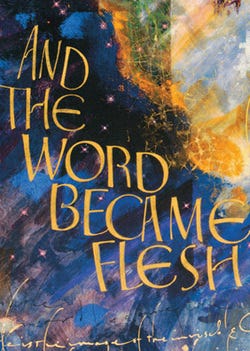
Christ Our Light, detail, by Donald Jackson from The Saint John’s Bible
Inspirational Quotes
 “The young clergyman and his wife do all the things you do on Christmas Eve. They string the lights and hang the ornaments. They supervise the hanging of the stockings. They tuck in the children. They lug the presents down out of hiding and pile them under the tree. Just as they’re about to fall exhausted into bed, the husband remembers his neighbor’s sheep. The man asked him to feed them for him while he was away, and in the press of other matters that night he forgot all about them.

So down the hill he goes through knee-deep snow. He gets two bales of hay from the barn and carries them out to the shed. There’s a forty-watt bulb hanging by its cord from the low roof, and he turns it on. The sheep huddle in a corner watching as he snaps the baling twine, shakes the squares of hay apart, and starts scattering it. Then they come bumbling and shoving to get at it with their foolish, mild faces, the puffs of their breath showing in the air. He is reaching to turn off the bulb and leave when suddenly he realizes where he is. The winter darkness. The glimmer of light. The smell of the hay and the sound of the animals eating.

Where he is, of course, is the manger. He only just saw it. He whose business it is above everything else to have an eye for such things is all but blind in that eye. He who on his best days believes that everything that is most precious anywhere comes from that manger might easily have gone home to bed never knowing that he had himself just been in the manger. The world is the manger. It is only by grace that he happens to see this other part of the miracle.”—Frederick Buechner, Whistling in the Dark1

“There is nothing so secular that it cannot be sacred, and that is one of the deepest messages of the Incarnation.”―Madeleine L’Engle

“But there are not a few who are beginning to feel the futility of adding more words to the constant flood of language that pours meaninglessly over everybody, everywhere, from morning to night. For language to have meaning, there must be intervals of silence somewhere. … For the mercy of God is not heard in words unless it is heard, both before and after the words are spoken, in silence.”—Thomas Merton, Disputed Questions2

   A Christmas Poem
    by Leo Hartshorn

The Word
packed up its heavenly tent
and moved to a new home
sweet home
in the belly, of all things
…. a virgin.
From flesh came flesh.
In a barnyard of beasts.
Pushed out onto the hard earth
like raw meat
hanging in the window of a butcher shop.
The screaming wonder
wrapped in strips of cloth,
a mummy for the tomb.
The Word entered the world
of babbling beings
unable to speak…a word.
While angels bent over the earth
silent as a whisper.

         Moonless Darkness Stands Between
              by Gerard Manley Hopkins3

Moonless darkness stands between.
Past, the Past, no more be seen!
But the Bethlehem-star may lead me
To the sight of Him Who freed me
From the self that I have been.
Make me pure, Lord: Thou art holy;
Make me meek, Lord: Thou wert lowly;
Now beginning, and alway:
Now begin, on Christmas day.

                      Incarnation
             by Penelope Duckworth4

When the Holy One stepped from endless order
into the chaos of our days, it was winter.
Weather blew everywhere.  Time itself was dying.
The squirrel, with a tail soft as breath,
curled inside the maple trunk.

The cold stayed.  Five-fingered leaves pressed the ground,
their stems perpendicular, thin wrists above each flame-tipped palm.
Cataclysm scanned the days; like any future, like our own.
The Holy One took face and voice, beginning with an infant cry,
took food and sleep, nestled in arms not unlike yours.

He listened to the dropping rain, watched it bead the naked twigs,
saw it polish stones and faces, stood once under this lift of sky
and still, in a word, understands.
1 Frederick Buechner, Whistling in the Dark (San Francisco: HarperSanFrancisco, 1993) 29-30.
2 Thomas Merton, Disputed Questions (New York: Farrar, Strauss & Cudahy, 1960) 194.
3 Gerard Manley Hopkins, The Poems of Gerard Manley Hopkins, ed. W.H. Gardner and N.H. MacKenzie (London: Oxford University Press, 1967) 170.
4 Penelope Duckworth, I Am: Teaching Sermons on the Incarnation (Abingdon Press, 1998)