

Sunday’s Reflection—Dives and Lazarus
September 29, 2025

Luke 16:19-31
Jesus said, "There was a rich man who was dressed in purple and fine linen and who feasted sumptuously every day. And at his gate lay a poor man named Lazarus, covered with sores, who longed to satisfy his hunger with what fell from the rich man's table; even the dogs would come and lick his sores. The poor man died and was carried away by the angels to be with Abraham. The rich man also died and was buried. In Hades, where he was being tormented, he looked up and saw Abraham far away with Lazarus by his side. He called out, `Father Abraham, have mercy on me, and send Lazarus to dip the tip of his finger in water and cool my tongue; for I am in agony in these flames.' But Abraham said, `Child, remember that during your lifetime you received your good things, and Lazarus in like manner evil things; but now he is comforted here, and you are in agony. Besides all this, between you and us a great chasm has been fixed, so that those who might want to pass from here to you cannot do so, and no one can cross from there to us.' He said, `Then, father, I beg you to send him to my father's house-- for I have five brothers-- that he may warn them, so that they will not also come into this place of torment.' Abraham replied, `They have Moses and the prophets; they should listen to them.' He said, `No, father Abraham; but if someone goes to them from the dead, they will repent.' He said to him, `If they do not listen to Moses and the prophets, neither will they be convinced even if someone rises from the dead.'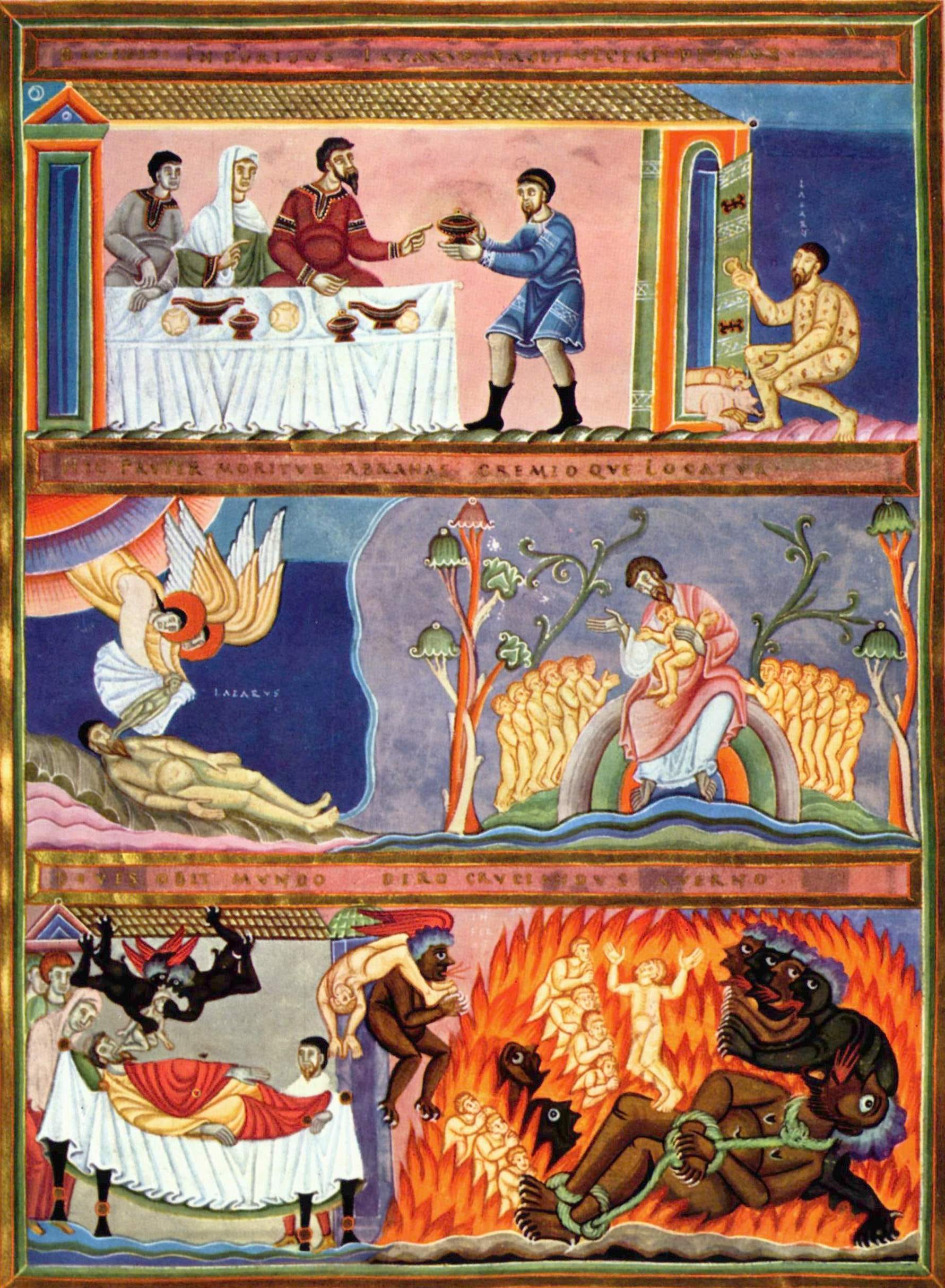
     “Lazarus and Dives,” fol. 78r from the Codex Aureus of Echternach, ca. 1035–40.
German National Museum, Nuremberg, Germany.This is a true story found in an article dated April 8, 2007 by Gene Weingarten published in the Sunday magazine of the Washington Post. It was called "Pearls Before Breakfast” and won a Pulitzer Prize for journalism. On January 12, 2007 at 7:51 A.M., in the middle of rush hour, a man wearing a baseball cap, a t-shirt, and jeans went busking with his violin at the L'Enfant Plaza Metro station in Washington, DC. The first piece he played was Bach's 14-minute Chaconne (Violin Partita No. 2 in D Minor), generally considered to be the single greatest solo violin composition ever created. Over a period of forty-three minutes, the violinist performed six classical pieces, three by Bach, one by Massenet, and one each by Schubert and Ponce. Out of 1,097 people who passed by, only seven stopped to listen for any length of time, and the violinist collected a total of $52.17. No one knew this, but the violinist was Joshua Bell, one of the greatest musicians in the world. He played on a Stradivarius violin worth $3.5 million dollars. Two days before, Joshua Bell sold out a theater in Boston where the seats averaged $100.

Joshua Bell playing his violin at the L'Enfant Plaza Metro station in Washington, DC.
      Joshua Bell playing incognito in the metro station was organized by the Washington Post as part of a social experiment about perception, taste, and people's priorities. The questions that arose were:
1) In a commonplace environment at an inappropriate hour, do we perceive beauty?
2) Do we stop to appreciate it? Do we recognize talent in an unexpected context?

	One possible conclusion that can be drawn from this experiment is this: If we do not have a moment to stop and listen to one of the best musicians in the world, playing some of the finest music ever written, with one of the most beautiful instruments ever made.... What else are we missing?

	Today’s parable is about a rich fat cat, who liked to dress up in flashy purple clothes and a poor beggar, named Lazarus, covered with sores, dying of hunger. Even though Lazarus lay at the gate to his house, the rich man ignored him daily. Both of them die. Lazarus goes to heaven, to the bosom of Abraham, while the rich man goes to Hell and eternal torment.

	What makes this parable especially uncomfortable is that it speaks not only about sins of commission but also about sins of omission. It doesn’t so much speak about the bad things that we do, but about the good things that we fail to do.

	Mother Teresa of Calcutta put it best: “It is very fashionable to talk about the poor… unfortunately, it is not as fashionable to talk to the poor.”

Photo by Johan Mouchet on Unsplash
         We can bewail the plight of the poor—the really desperately poor—but do we in fact know these people personally? Or do we see them as something to be avoided as they sleep on cardboard on the sidewalk? Do we ignore people asking for food or money with their cardboard signs? Who always say “God Bless you,” when you say no, and “have a nice day” as you walk away.

        This was brought home to me recently when my husband and I traveled to New York City and found a homeless man in rags, dead drunk, sleeping on a blanket directly in front of a subway turnstile. To get through the turnstile, you literally had to step over him. Fortunately, there were other turnstiles in operation, and we went through them. We felt helpless to do anything—the sight sent a dagger through my heart. Here was Lazarus in the flesh.

           It’s not surprising that Luke writes about the dangers of focusing your life on amassing wealth. The religious leaders and Pharisees of Jesus’ days were lovers of money, which they wouldn’t admit. Jesus told this story in an attempt to convict the religious leaders of their sin.

          The rich man had a wonderful life, lived in a wealthy, gated home, and every night was party night. But Lazarus, the poor beggar, starved on his doorstep. His only “friends” were the stray dogs who licked his wounds. Then both men died on the same day. The two, who had been so far apart in life, were now equal in death. One scholar used a colorful phrase to describe death. He called it the “moment of dreadful equity.”

        Preacher Barbara Brown Taylor says that one of the difficulties of this passage is that we don’t identify with anyone in the parable. Most of us are neither rich nor desperately poor. According to the U.S. Census Bureau, the level of poverty in this country has decreased since 2015, when the official poverty rate was 13.5%. In 2024, the official poverty rate in the USA was 10.6%. The 2025 Federal Poverty Guidelines (FPL), which define the minimum income needed to avoid poverty, were released earlier in the year and increased by 2.9% from 2024. The FPL for a household of one is $15,650, and for a family of four, it is $32,150. Clearly, because of the Trump administration, people are becoming poorer. But as an African proverb goes, “Statistics are numbers without tears.”

         Like the people passing Joshua Bell in the subway, the rich man goes to hell because he never opened his eyes (much less his heart) to see Lazarus’ plight on his own doorstep. If you define sin (and hell) as separation from God, ourselves, and each other, then the important point of this story is that the rich man sent himself to hell with his lack of compassion. God did not send him there. The rich man created a chasm between himself and God when he created a chasm between himself and Lazarus.

         The question is: are we willing to start building bridges instead of making the chasm bigger? Money itself is not bad—remember the Bible says it’s "the love of money is the root of all evil.” Money is necessary and useful. It can be redemptive not only to those who receive it, but for those who give it. It can bring life.

          The constant temptation is that we settle for less. As Barbara Brown Taylor wrote: “Jesus could not stand the way people loved the things they could get for themselves better than the way they loved the things God wanted to give them. They were satisfied with linen suits and sumptuous feasts when God wanted to give them the kingdom. They were content to live in the world with beggars…when God wanted to give them brothers and sisters. They were happy to get by with the parts of the Bible that backed up their own ways of life when God wanted to give them a new life altogether.”1

         That is why we love stories about people who settle for more—who take the widows mite of their lives and make something BIG out of it. Like the story of Margaret Frances Wosser who died in San Francisco on May 22, 1995 at age 79.

A Laundromat on Castro Street, San Francisco, CA
         Margaret Wosser owned and ran a coin laundromat in the Castro District called the Castro Wash and Dry. Though she started out poor, by the time she died, she had amassed a huge fortune, one quarter at a time. When her estate was made public, people were stunned to discover how much money she had – about $1.25 million. First, Margaret Wosser left $1 million to Episcopal Charities of the Diocese of California for helping her son, who had died of AIDS a few years before. She also left large amounts of money to the San Francisco Public Library, the Exploratorium, the Museum of Modern Art, the De Young Museum, the San Francisco Zoological Society, and secretly funded the expenses for several university students.

	Aside from the money, she was known for turning her laundromat into a house of hospitality—a place for neighbors to gather. Friends recalled that Wosser swept the sidewalks in front of the establishment every day, sometimes sweeping the entire block. She would often raffle off turkeys, TVs, and VCRs to help people in need. She loved to throw pizza parties for the neighborhood just because she could. Margaret Wosser thought and lived big.

	I write this not to make you feel guilty but to imagine what might be possible. Remember, the story of Abraham and Lazarus is not a prediction. The rich are not automatically damned, nor are the poor automatically saved. Your personal story hasn’t ended yet. It all depends on what you do with what you have.

 	If you had an extra $10,000, what would you do with it? Start a Giving Fund? Give it all away? Give half away, give away 10%? Like Margaret Wosser, you don’t have to be a millionaire to do this. She did it 25¢ at a time.

	Remember how Dickens’s story A Christmas Carol ends?  Scrooge danced with joy once he found new life by being generous. 1st Timothy calls us to be “rich in good works, generous, and ready to share.” We need to do this—not simply because God wants us to be generous but because God wants us to take hold of the life that really is life—and not settle for second best.
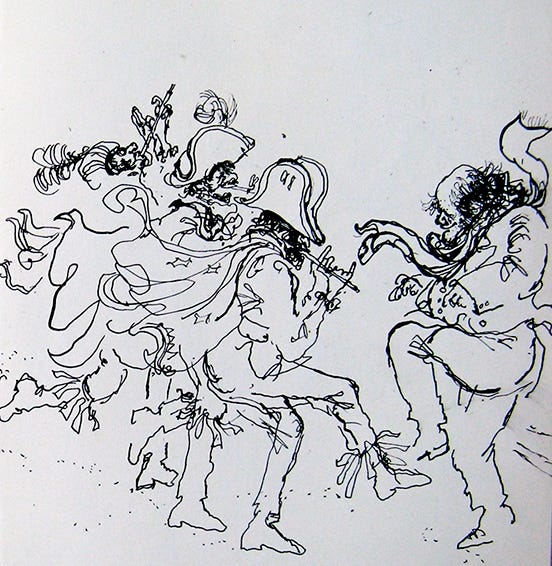
Ebenezer Scrooge Dancing by Robert Searle, 1970
Inspirational Quotes
 “The wise man does not lay up his own treasures. The more he gives to others, the more he has for his own.”—Lao Tzu

“You make all kinds of mistakes, but as long as you are generous and true and also fierce, you cannot hurt the world or even seriously distress her.”―Winston S. Churchill

“Generosity is the most natural outward expression of an inner attitude of compassion and loving-kindness.”―Dalai Lama

Success isn’t about how much money you make; it’s about the difference you make in people’s lives.”—Michelle Obama
   Dives and Lazarus

As it fell out upon one day,
Rich Divès made a feast,
And he invited all his friends,
And gentry of the best.

Then Lazarus laid him down and down
And down at Divès’ door:
Some meat and drink, brother, Diverus,
Bestow upon the poor.

Thou’rt none of mine, brother Lazarus,
That lyest begging at my door;
No meat, nor drink will I give you,
Nor bestow upon the poor.

Then Divès sent to his merry men,
To whip poor Lazarus away;
They’d not the power to strike one stroke,
But flung their whips away.

Then Lazarus laid him down and down,
Even down at Divès’ gate.
Some meat, some drink, brother Diverus,
For Jesus Christ sake.

Thou’rt none of mine, brother Lazarus,
Lies begging at my gate;
No meat, no drink will I give you,
For Jesus Christ sake.

Then Divès sent out his hungry dogs,
To bite him as he lay;
They had no power to bite at all,
But licked his sores away.

As it fell out all a day,
Poor Lazarus sickened and died;
There came two angels out of Heaven,
His soul therein to guide.

Rise up! rise up! brother Lazarus,
Go along with me;
For you’ve a place prepared in Heaven,
To sit on an angel’s knee.

As it fell out all on a day,
Rich Divès sickened and died;
There came two serpents out of hell,
His soul therein to guide.

Rise up! rise up! brother Diverus,
And go with us and see;
A place prepared in dismal hell
from which thou can’st not flee.

Then Divès looked up with his eyes
And saw poor Lazarus blest;
Give me one drink, brother Lazarus,
To quench my flaming thirst.

O, was I but alive again
In the space of one half hour!
But then my peace would be secure,
The devil should have no power.
Dives and Lazarus sung by Maddy Prior (best known as the lead vocalist of Steeleye Span) and the Carnival Band perform Dives and Lazarus at the Nettlebed Folk Club on their "Seven For Old England" tour. The song is taken from the album of the same name, Seven For Old England. It is a traditional English carol, possibly from Herefordshire.
             Greed
   By Philip Schultz2

Share
My ocean town struggles
to pick up leaves,
offer summer school,
and keep our library open.
Every day now
more men stand
at the railroad station,
waiting to be chosen for work.
Because it’s thought
the Hispanics will work for less
they get picked first,
while the whites and blacks
avoid the terror
in one another’s eyes.
Our handyman, Santos,
who expects only
what his hands earn,
is proud of   his half acre in Guatemala,
where he plans to retire.
His desire to proceed with dignity
is admirable, but he knows
that now no one retires,
everyone works harder.
My father imagined a life
more satisfying than the one
he managed to lead.
He didn’t see himself as uneducated,
thwarted, or bitter,
but soon-to-be rich.
Being rich was his right, he believed.
Happiness, I used to think,
was a necessary illusion.
Now I think it’s just
precious moments of relief,
like dreams of Guatemala.
Sometimes, at night,
in winter, surrounded by
the significant silence
of empty mansions,
which once were cottages,
where people lived their lives,
and now are owned by banks
and the absent rich,
I like to stand at my window,
looking for a tv’s futile flickering,
always surprised to see
instead
the quaint, porous face
of my reflection,
immersed
in its one abundance.
BLESSING THE FRAGMENTS
           by Jan Richardson3

Cup your hands together,
and you will see the shape
this blessing wants to take.
Basket, bowl, vessel:
it cannot help but
hold itself open
to welcome
what comes.
This blessing
knows the secret
of the fragments
that find their way
into its keeping,
the wholeness
that may hide
in what has been
left behind,
the persistence of plenty
where there seemed
only lack.
Look into the hollows
of your hands
and ask
what wants to be
gathered there,
what abundance waits
among the scraps
that come to you,
what feast
will offer itself
from the fragments
that remain.1 Barbara Brown Taylor, Bread of Angels (Cambridge, MA: Cowley Publications, 1997) 112. 2 Philip Schultz, Luxury: Poems (New York: W.W. Norton & Co, 2018) 11. 3 Jan Richardson, The Cure for Sorrow: A Book of Blessings for Times of Grief (Orlando, FL: Wonton Gospeller Press, 2016) 161.