

Sunday’s Reflection—Doubting Thomas
April 12, 2026

John 20:19-31
         When it was evening on that day, the first day of the week, and the doors of the house where the disciples had met were locked for fear of the Jews, Jesus came and stood among them and said, "Peace be with you." After he said this, he showed them his hands and his side. Then the disciples rejoiced when they saw the Lord. Jesus said to them again, "Peace be with you. As the Father has sent me, so I send you." When he had said this, he breathed on them and said to them, "Receive the Holy Spirit. If you forgive the sins of any, they are forgiven them; if you retain the sins of any, they are retained."
          But Thomas (who was called the Twin), one of the twelve, was not with them when Jesus came. So the other disciples told him, "We have seen the Lord." But he said to them, "Unless I see the mark of the nails in his hands, and put my finger in the mark of the nails and my hand in his side, I will not believe."
           A week later his disciples were again in the house, and Thomas was with them. Although the doors were shut, Jesus came and stood among them and said, "Peace be with you." Then he said to Thomas, "Put your finger here and see my hands. Reach out your hand and put it in my side. Do not doubt but believe." Thomas answered him, "My Lord and my God!" Jesus said to him, "Have you believed because you have seen me? Blessed are those who have not seen and yet have come to believe."
         Now Jesus did many other signs in the presence of his disciples, which are not written in this book. But these are written so that you may come to believe that Jesus is the Messiah, the Son of God, and that through believing you may have life in his name.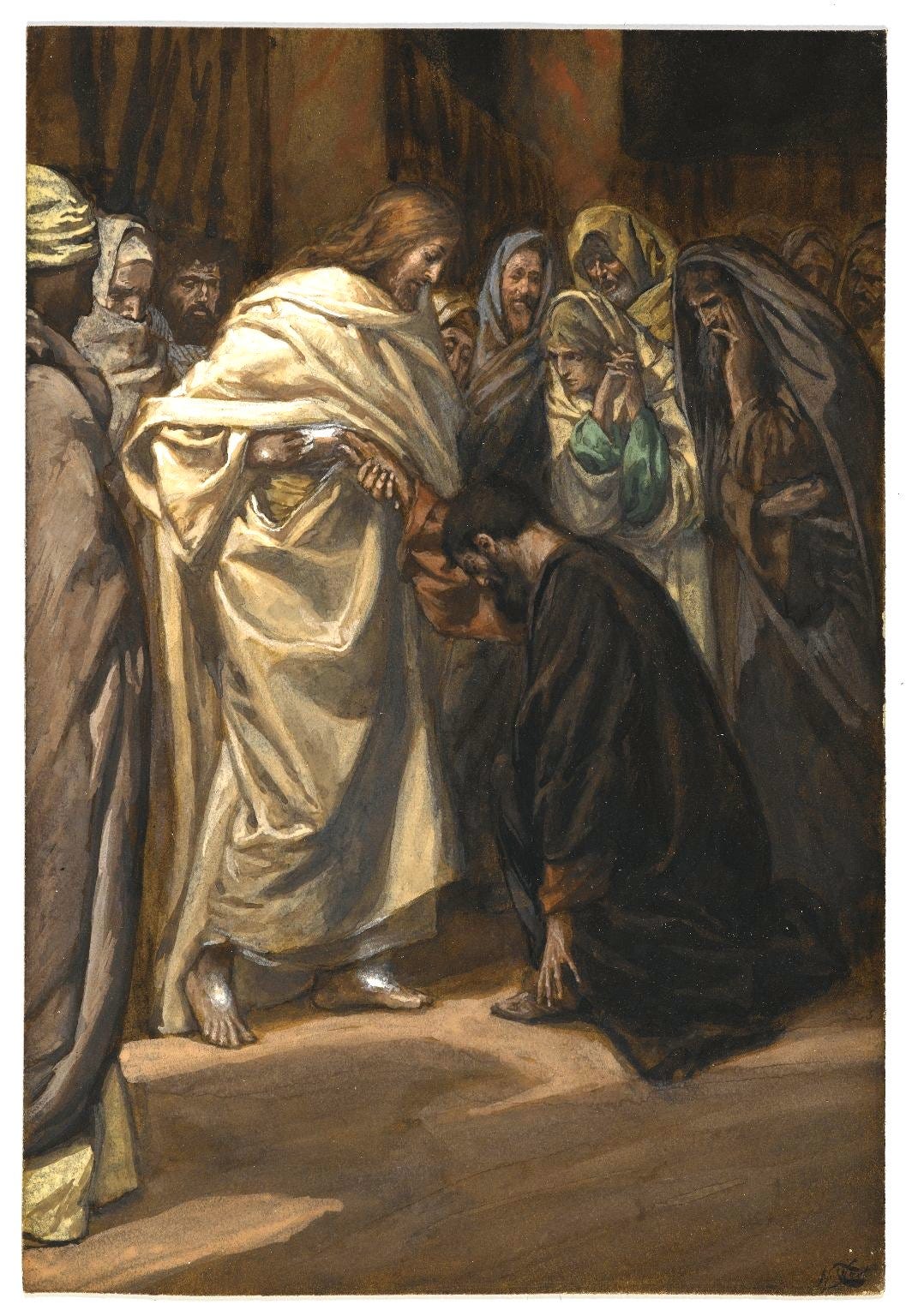
The Disbelief of St. Thomas, James Tissot, 1886–1894, Brooklyn Museum
          It’s only been a week since the day of Jesus’ resurrection and yet the disciples are quaking with fear behind lock doors. They are afraid they too will be arrested and crucified. This is like so many immigrant families today, forced to hide behind closed doors, afraid to go shopping, or even go into their own driveways for fear of being brutally arrested without a warrant by ICE Agents and separated from their spouse and children, and deported.

	When St. John described the house, the locked doors, he is speaking about more than a physical house with walls, locked doors, and deadbolts. He was describing the interior condition of the disciples’ souls. The locked places of our lives are always more about what is going on inside of us than what's outside or around us.

	The Anglican priest and writer Suzanne Guthrie called Doubting Thomas her hero. She wrote in The Christian Century:
          “Like Thomas, I was absent when Jesus breathed on the disciples. I was missing from the line-up when the faith gene was distributed. (What do those believing Christians have that I don’t?)
            Like Thomas, I want truth. I don’t want a faith of smoke and mirrors. I know that a faith even slightly off trajectory eventually veers far off the mark. Faced with my own tardiness, depending upon second-hand accounts, whom will I believe? Imagine what Thomas is thinking when Simon Peter declares, “We have seen the Lord!”
       You have seen the Lord, Mr. Simon Let’s-build-three-booths Peter?
       You have seen the Lord, Mr. Simon God-forbid-Lord-This- shall-never-happen-to-you Peter?
        You have seen the Lord, Mr. Simon You-shall-never-wash-my-feet-Not-my-feet-only-but-also-my-hands-and-my-head Peter?
        You have seen the Lord, Mr. Simon I’ll-never-deny-thee-deny-thee-deny thee Peter?
        Family-picnic-wise, who would I believe? My own mother? (pause). Nope. My brother? (long pause). Nope. My children? (even longer pause). Nope. Cousin Thomas? Cousin Thomas who said, “Unless I see in his hands the print of the nails, and place my finger in the mark of the nails, and place my hand in his side, I will not believe”? Yes!”1

	Jesus didn’t penalize Thomas for doubting His resurrection. He certainly won’t penalize you if you have misgivings about it too. We are not saved by our intellectual beliefs but by our faith, by our trust, and our reliance on God—despite our beliefs or disbeliefs.

	The truth is that our capacity for intellectual belief grows, matures, and changes, just as our mind develops and matures with age. What I believed at five is very different from what I believed at fourteen, at forty, or at seventy.

	The poet Christian Wiman was raised as an evangelical Southern Baptist in a West Texas town, which he says was so deeply religious that “to call the place predominantly Christian is like calling the Sahara predominantly sand.”2  Wiman was so immersed in conservative Christianity that he never met an actual unbeliever until he went to college. However, his studies at Washington and Lee University in Lexington, Virginia, provided Wiman the necessary distance to see his religious heritage for what it was—an increasingly odd and unfashionable outlier in the modern world.
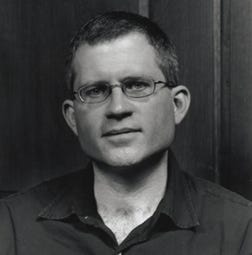
Christian Wiman, 2013
	After college, Wiman became a successful poet for the next twenty years and was the editor of the preeminent American magazine of verse, Poetry. But then cancer struck, and he was diagnosed with a rare and incurable blood cancer (Waldenström's macroglobulinemia) at age 39. Wiman found himself in an extreme crisis that forced him to grapple with his mortality. At the same time, he fell in love, married, began praying with his wife, and eventually joined the United Church of Christ Church (UCC).

	He wrote My Bright Abyss to communicate with those who felt a longing for God but were alienated by modern religion, exploring what a "viable contemporary faith" looks like in the face of doubt and suffering. He wrote, “Sometimes God calls a person to unbelief in order that faith may take new forms.”3

	One of the great hallmarks of being an Anglican, an Episcopalian, is our capacity to be comfortable with questions and doubt—to entertain the grey areas and not just the black and white ones. In fact, our denomination encourages us to ask questions because it makes us delve deeper into the mystery of God. Without Thomas’ doubts, we wouldn’t have been given the deeper revelation of Christ in that Upper Room, when he showed Thomas, the disciples, and us, his hands and his side.

	Thomas didn't doubt to reject the truth, but to find it. A faith forged in the fire of questioning is always stronger than one accepted by default.
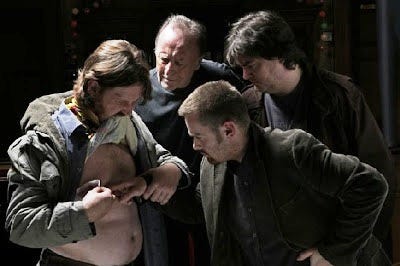
Photograph by Andy Moxon
       Jesus doesn’t want us to get rid of our doubts—but he does want to deliver us from the bondage of fear.

	I wonder, one week after Easter, how your and my lives are really different because of Jesus’s Resurrection? How are you living—in the freedom and joy of resurrection or is it life as usual? Or life, given our current political reality, living in fear?  What keeps us from the deep joy of Easter?

	Maybe we, like the disciples, are still living in fear. Maybe our questions, disbelief, or the conditions we place on our faith keep us from this joy? Perhaps sorrow and loss block it. Maybe the wounds are so deep it does not seem worth the risk to step outside. Maybe its anger and resentment we can’t let go of. Maybe life is so overwhelming, so busy, that to do one more thing is just too much to ask—especially, if it is to open up to new ideas, possibilities, and change.

	Jesus offers us peace and the Holy Spirit if we will accept them—but we must open the door from the inside. And sometimes, when we refuse to open up, Jesus walks through the door anyway.

        When Jesus did this, Thomas’s response was: “My Lord and My God!” What will your response be?
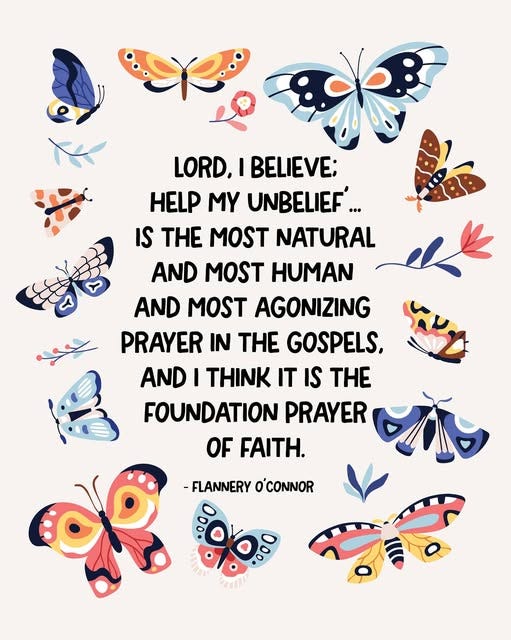
Inspirational Quotes
The old faith must die, eaten away by doubts, but only so that a new and deeper faith may be born.—Paul Tillich, Dynamics of Faith

Eight days later, when Jesus did come back, Thomas was there and got his wish. Jesus let him see him and hear him and touch him, and not even Thomas could hold out against evidence like that. He had no questions left to ask and not enough energy left to ask them with, even if he'd had a couple. All he could say was, "My Lord and my God!" (John 20:28), and Jesus seemed to consider that, under the circumstances, that was enough.”—Frederick Buechner, Beyond Words

I never truly felt the pain of unbelief until I began to believe.—Christian Wiman, My Bright Abyss

“Lord, I believe; help my unbelief” isn’t a failure of faith. Its faith stripped down to the bone. Faith that knows it cannot save itself. Faith that understands grace is not a reward for certainty but a gift given right in the middle of confusion, fear, and longing.—Lauren Winter, Brick House in the City

You know the value of your doubt by the quality of the disquiet that it produces in you.—Christian Wiman, O Thou Mastering Light

Great Doubt: great awakening. Little Doubt: little awakening. No Doubt: no awakening.—Ku San Sunim, 20th-century Korean Zen master
        My Bright Abyss
     by Christian Wiman4

My God my bright abyss
Into which all my longing will not go
Once more I come to the edge of all I know
And believing nothing believe in this: St. Thomas Didymus [the Twin]
by Denise Levertov5
And after the empty tomb
when they told me He lived, had spoken to Magdalen,
told me that though he had passed through the door like a ghost
He had breathed on them the breath of a living man—
even then when hope tried with a flutter of wings to lift me—
still, alone with myself, my heavy cry was the same:
Lord, I believe, help my unbelief.
I needed blood to tell me the truth,
the touch of blood.
Even my sight of the dark crust of it round the nailholes
didn’t thrust its meaning all the way through to that manifold knot in me
that willed to possess all knowledge,
refusing to loosen unless that insistence won the battle I fought with life.
But when my hand led by His hand’s firm clasp entered the unhealed wound,
my fingers encountering rib-bone and pulsing heat,
what I felt was not scalding pain, shame for my obstinate need,
but light, light streaming into me, over me,
filling the room as if I had lived till then in a cold cave,
and now coming forth for the first time,
the knot that bound me unravelling,
I witnessed all things quicken to color, to form,
my question not answered but given its part
in a vast unfolding design lit by a risen sun.1 Suzanne Guthrie, “Here’s How I Came to Know the Real Cousin Thomas,” The Christian Century, March 22, 2005. 2 Christian Wiman, My Bright Abyss: Meditation of a Modern Believer (New York : Farrar, Straus and Giroux, 2013) 5. 3 Christian Wiman, My Bright Abyss: Meditation of a Modern Believer, Ibid., 61. 4 Christian Wiman, My Bright Abyss: Meditation of a Modern Believer, Ibid, 3. 5 Denise Levertov, The Stream and the Sapphire: Selected Poems on Religious Themes (New York: New Directions, 1997) 83.