

Sunday’s Reflection—Room for All
May 3, 2026

John 14:1-14
Jesus said, “Do not let your hearts be troubled. Believe in God, believe also in me. In my Father’s house there are many dwelling places. If it were not so, would I have told you that I go to prepare a place for you? And if I go and prepare a place for you, I will come again and will take you to myself, so that where I am, there you may be also. And you know the way to the place where I am going.” Thomas said to him, “Lord, we do not know where you are going. How can we know the way?” Jesus said to him, “I am the way, and the truth, and the life. No one comes to the Father except through me. If you know me, you will know my Father also. From now on you do know him and have seen him.”

Philip said to him, “Lord, show us the Father, and we will be satisfied.” Jesus said to him, “Have I been with you all this time, Philip, and you still do not know me? Whoever has seen me has seen the Father. How can you say, ‘Show us the Father’? Do you not believe that I am in the Father and the Father is in me? The words that I say to you I do not speak on my own; but the Father who dwells in me does his works. Believe me that I am in the Father and the Father is in me; but if you do not, then believe me because of the works themselves. Very truly, I tell you, the one who believes in me will also do the works that I do and, in fact, will do greater works than these, because I am going to the Father. I will do whatever you ask in my name, so that the Father may be glorified in the Son. If in my name you ask me for anything, I will do it.”
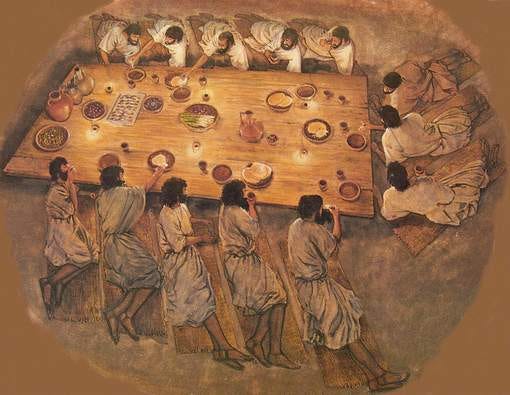
The Last Supper, by James Tissot, 1896, Brooklyn Museum
         The words in today’s Gospel, which Jesus spoke to his disciples at the Last Supper, are some of the most beloved in all of scripture. Whenever I do a funeral, people almost always pick this passage to be read aloud because they find it so consoling.

	And while it is comforting and beautiful—if you listen to it closely and think about it, this has to be one of the most confusing passages in the Bible.

	This is because Jesus says two opposite things, one right after another:
                                 “In my father’s house are many mansions.”
“I am the way, and the truth, and the life. No one comes to the Father except through me.”
         Why is that? Is Jesus speaking out of both sides of his mouth at the same time?

        The passage: “In my father’s house are many mansions” has been used by many to show God’s inclusivity. All are welcome.

	While the verse: “I am the way, and the truth, and the life. No one comes to the Father except through me” has been used to prove that Jesus Christ is the only way to God. Unfortunately, as a result, this has given Christians throughout the centuries an excuse to exclude, attack, and even kill those who don’t believe in Jesus Christ.

	Today, among the many culture wars going on in our country, one of the biggest fights is between those with an exclusive view of Jesus and those with an inclusive view—the fight between Evangelical Christian fundamentalism and mainstream Christian pluralism. The fight is about who’s in and who’s out—about diversity, equity, and inclusion.

	At one extreme, fundamentalists say that Jesus is the only way to God and salvation, and no other religion offers that.  At the other end, theological pluralists take a more relaxed approach, believing that no single religious tradition has a monopoly on truth, viewing many religions as different cultural responses to the same ultimate reality.

	As a good Anglican, I say that both are partly wrong and both are partly right. How’s that for contradiction and confusion? Just like the way human beings are one and different at the same time.

	The pluralistic perspective can be summed up by the beautiful traditional Japanese saying: "Although the paths to the summit may differ, from the top one sees the same moon." This saying suggests that despite their outward differences, all religions connect with the same divine reality whose name is Love.

	However, you have to admit that some religious views and practices are clearly false, harmful, and even despicable. I don't think that Inca human sacrifice is equal to Buddhist pacifism. Nor do I think the Hindu practice of Sati, when a widow immolates herself on her dead husband’s funeral pyre  (now universally banned in India), is holy. Neither did the ancient practice of Chinese female infanticide, nor the mass suicide of 913 people at Jonestown have anything to do with moral and Godly religion. So, to say that all religious views are equally valid is wrong.

	Likewise, to say that all religions teach the same thing is precisely what religions do not do. It is true, at one level, many religions preach variations of the Golden Rule: “Do unto others as you would have them do unto you.” But when you examine the historical and theological particulars of religions, you discover drastic differences.

	Judaism, Christianity, and Islam are all famous for their "radical monotheism," but each one teaches that its religious approach is the correct path. Shinto and many African traditional religions are polytheistic. Buddhism is non-theistic, and the scientific materialism of Marx, the writer Christopher Hitchens, and the evolutionary biologist Richard Dawkins are atheistic. To say that these religions and philosophies are equally true is illogical. Monotheism and polytheism, for example, or Theism and atheism, cannot both be right. C.S. Lewis famously said in Mere Christianity, “As in arithmetic—there is only one right answer to a sum, and all other answers are wrong, but some of the wrong answers are much nearer being right than others."1

	Jesus constantly pushed against the Jewish establishment of his day, which excluded everyone but physically perfect Jewish males of a certain socio-economic class from the inner courts of the Temple.

	Jesus lived and preached an inclusive Gospel which included men, women, children, Gentiles, the blind, the sick, the lame, the clean and unclean, tax collectors and sinners, the rich and the poor—everyone. When Jesus says, “In my father’s house there are many mansions”, the literal Greek translation is: “In my father’s house there are many dwelling places—many abodes.”

	This does not mean that God created heaven as the great suburban sub-division in the sky. Clearly, Jesus was not talking about literal buildings—my hunch is that He was talking about many ways of being or dimensions of living in God.

	I like C.S. Lewis’s thoughts about this in his book Mere Christianity: "Is it not frightfully unfair that this new life should be confined to people who have heard of Christ and been able to believe in Him? But the truth is, God has not told us what His arrangements about the other people are. We do know that no man can be saved except through Christ; we do not know that only those who know Him can be saved through Him."2

	Wiley Miller’s cartoon sums it up for me.
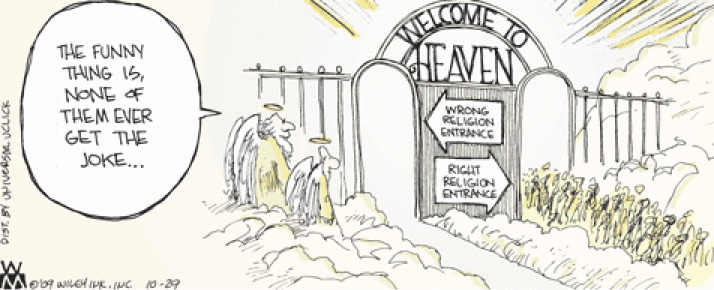
        Speaking plainly—it’s none of our business. Our job is, as St. Paul says, to “work out our salvation with fear and trembling.” The rest is up to God.

	I’ll end with a story by Fr. Robert Llewellyn, (who I was fortunate enough to meet and interview in Norwich, England, in 1994.) He was an Anglican priest who was considered a very holy spiritual director, teacher, writer, and confessor. He served parishes and schools in Nainital and Pune, India for almost twenty years. Later, he became an authority on Julian of Norwich and was chaplain at her hermitage and shrine for thirty years until his death in 2008.

	In his book Thirsting for God, he tells the story which he heard from Dr. E. Stanley Jones, an American Methodist missionary ministering in India from 1907 until he died in 1973. Dr. Jones reestablished the Christian ashram movement in India and worldwide by founding the Sat Tal Ashram in the Himalayan foothills of India in 1930. He was an "inculturation" pioneer who adopted the dress, diet, and sitting styles of Indian holy men to bridge the gap between East and West. He was a close friend and biographer of Gandhi and also knew Jawaharlal Nehru well. Reinhold Niebuhr described Dr. Stanley Jones as "one of the great saints of his time." In 1962, Jones was nominated for the Nobel Peace Prize and in 1963 Dr. Jones received the Gandhi Peace Prize.
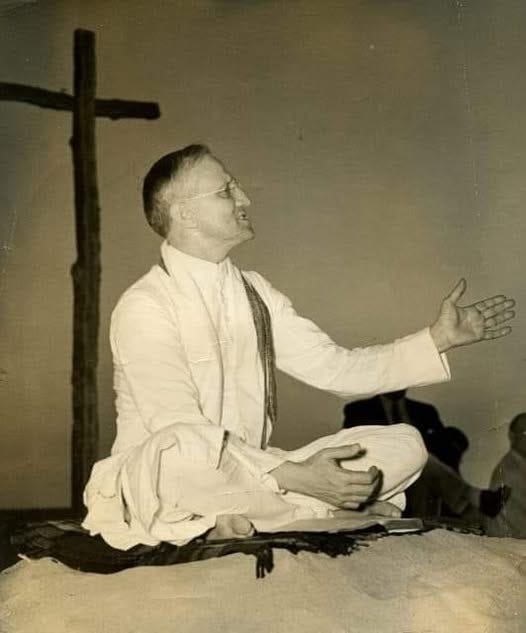
                      The Rev. Dr. E. Stanley Jones, teaching at his Sat Tal Ashram
Nainital, Uttarakhand, India, 1950s.Fr. Robert Llewellyn wrote, “Dr. Jones, as often happened, was speaking about Christ to a group of Christians and Hindus in Bombay. When he was done, an elderly and devout Hindu came to the platform and said, “Sir, I thank you, I have known Him all my life, and now you have told me His name.”3
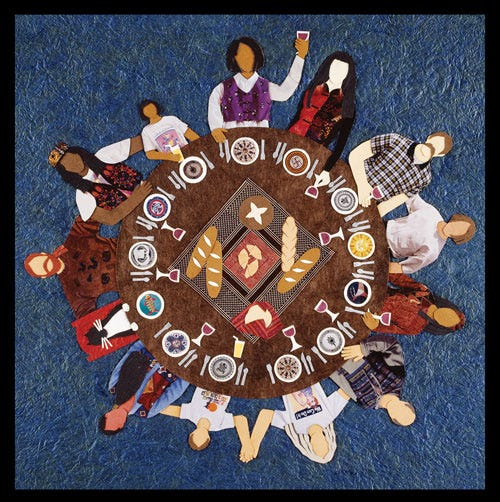
The Best Supper, by Jan Richardson
Inspirational Quotes
We all should know that diversity makes for a rich tapestry, and we must understand that all the threads of the tapestry are equal in value no matter what their color.—Dr. Maya Angelou

Diversity is being invited to the party; inclusion is being asked to dance.—Verna Myers

Our unity is our strength, and our diversity is our power.—Kamala Harris

For Jesus, there are no countries to be conquered, no ideologies to be imposed, no people to be dominated. There are only children, women and men to be loved.—Henri Nouwen

Before Christianity developed the relatively safe ritual meal we call the Eucharist, Jesus’ most consistent social action was eating in new ways and with new people, encountering those who were oppressed or excluded from the system.—Richard Rohr
   On Meeting a Stranger
     by John O’Donohue4

With respect
And reverence
That the unknown
Between us
Might flower
Into discovery
And lead us
Beyond
The familiar field
Blind with the weed
Of weariness
And the old walls
Of habit.

                  The New Colossus
                   by Emma Lazarus5

Not like the brazen giant of Greek fame,
With conquering limbs astride from land to land;
Here at our sea-washed, sunset gates shall stand
A mighty woman with a torch, whose flame
Is the imprisoned lightning, and her name
Mother of Exiles. From her beacon-hand
Glows world-wide welcome; her mild eyes command
The air-bridged harbor that twin cities frame.
“Keep, ancient lands, your storied pomp!” cries she
With silent lips. “Give me your tired, your poor,
Your huddled masses yearning to breathe free,
The wretched refuse of your teeming shore.
Send these, the homeless, tempest-tost to me,
I lift my lamp beside the golden door!”

  There Are No Kings In America
          by Aileen Cassinetto6

We are not that kind of country.

We are sanctuary for the hungry,

the homeless, the huddled,

held together by an idea

our immigrant fathers believed in.

Rendered, it meant independence.

Pursued, it kindled war, ordnance,

a fighting chance. Forty thousand

musket balls, by themselves, did not

shape the boundaries on which we

map our days. To draw our borders,

we needed more than firecakes.

More than a pound of meat

with bone and gristle,

or salt fish and a gill of peas.

We needed the faith and grit of people

who were not yet Americans.

To be an American is to

recognize the sacrifice

of the widow and the orphan;

it is to understand the weft of tent

cities expecting caravans,

and the heft of a child in a camp

not meant for children, or sitting

before a judge awaiting judgement.

What do we say to the native

whose lands we now inhabit?

What do we say to our immigrant

fathers who held certain truths

to be self-evident?

Do we now still pledge to each

other our lives, our fortunes,

our sacred honor.

There are no kings in America.

Only gilded men we can topple

again and again. 1 C.S. Lewis, Mere Christianity (New York: Macmillan Polishers, 1952) 29. 2 C.S. Lewis, Ibid., 50. 3 Robert Llewellyn, Thirsting for God (London: Darton, Longman & Todd Ltd, 1986) 112. 4 John O’Donohue, To Bless the Space Between Us: A Book of Blessings (New York: Doubleday Publishers, 2008) 95. 5 "The New Colossus" was written in 1883 by Emma Lazarus and was mounted as a bronze plaque inside the pedestal of the Statue of Liberty in New York Harbor. 6 Aileen Cassinetto, Vox Populi Sphere, July 4, 2020.
Good job, Pamela. I loved the quote that diversity means being invited to the party. Inclusion means being asked to dance. Of course, the diverse tapestry that binds us all together is the love we bring with the diversity. Religious scriptures have been translated and interpreted many ways over thousands of years. They all reach the same conclusion. Love is the basis for unity of spirit. It is inside all of us. Why is this so hard for people to include this in their daily life and behaviors?