

Sunday’s Reflection—Wilderness Training
February 22, 2026

Matthew 4:1-11
       Jesus was led up by the Spirit into the wilderness to be tempted by the devil. He fasted forty days and forty nights, and afterwards he was famished. The tempter came and said to him, “If you are the Son of God, command these stones to become loaves of bread.” But he answered, “It is written,
	‘One does not live by bread alone,
	but by every word that comes from the mouth of God.’”
Then the devil took him to the holy city and placed him on the pinnacle of the temple, saying to him, “If you are the Son of God, throw yourself down; for it is written, ‘He will command his angels concerning you,’and ‘On their hands they will bear you up, so that you will not dash your foot against a stone.’”
	Jesus said to him, “Again it is written, ‘Do not put the Lord your God to the test.’”
Again, the devil took him to a very high mountain and showed him all the kingdoms of the world and their splendor; and he said to him, “All these I will give you, if you will fall down and worship me.” Jesus said to him, “Away with you, Satan! for it is written,
	‘Worship the Lord your God,
	and serve only him.’”
Then the devil left him, and suddenly angels came and waited on him.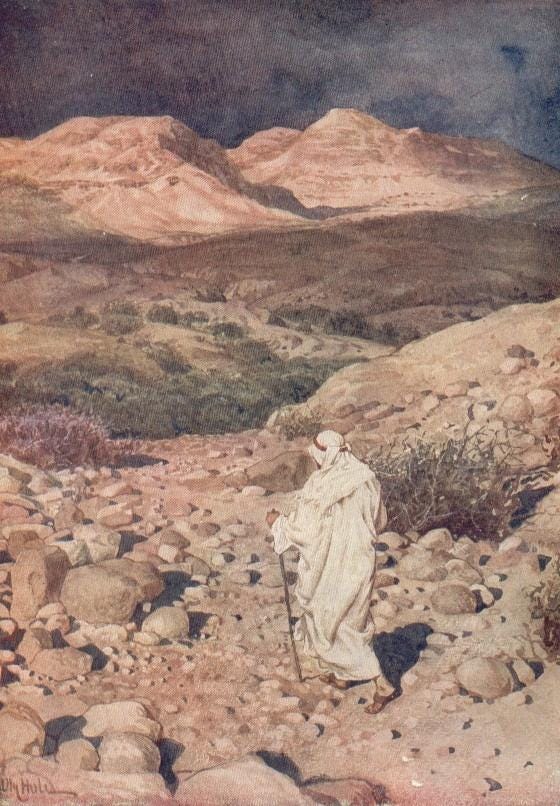
Temptation of Jesus in the Desert by William Hole from The Life of Jesus of Nazareth, 1908
      Today is the first Sunday of Lent. Time for us to experience the wilderness.

       I know about wilderness. Since the 1870s, my family has summered in the High Peaks of the Adirondacks on the eastern edge of that huge state park, larger than Rhode Island. Our house sits between two brooks beneath a large, 4,200-foot mountain in a great pine and deciduous forest. Deer, raccoons, porcupines, owls, and even brown bears are regular visitors.

       Often, we hiked and camped for a few days in this huge wilderness. Short visits were healing and refreshing, but it was never something to go into for weeks on end, without provisions or shelter. It was too dangerous. You can die in the wilderness without the proper training, equipment, food and water.

      When my brother was fifteen and sixteen in the late 1960s, he attended Ashcrofter’s Mountaineering School in the Colorado Rockies (something like the Outward Bound) for two summers. Ashcrofters focused on technical climbing, winter ski mountaineering, and backcountry education in the Elk Mountains and San Juan Mountains. My brother learned how to climb, to repel off steep cliffs, and basic wilderness survival skills with a tool called SHED, an acronym for finding Shelter, Heat, Edibles and Direction.

      The final test for all the campers came when each one was sent out to experience the wilderness alone for three days without basic food or water, supervised from afar by an adult counselor. My brother had to create a shelter to stay warm, find water, and forage for food, and correctly navigate wilderness terrain. The whole experience utterly changed and humbled him. He left home a rather spoiled and whiny boy and came back a man. I could see the difference in him immediately.

       Wilderness is both literal, whether it is in a forest or a desert, or it can be figurative. I sometimes think of ghettos as a kind of urban wilderness—a socio-economic desert where so many good people are forced to survive and somehow try to thrive. People feel deprived and alienated in this wilderness and many don’t make it out alive.

       Most of us avoid experiencing any kind of wilderness in our lives. Going into the wilderness alone and vulnerable, without support, is not something most sane people ever willingly do. Our whole civilization exists to be a buffer against the wildness of nature. When you live on the edge of a wilderness, you know how dangerous it is. It’s nothing you volunteer to enter.

      The wilderness Jesus experienced in the Jordanian desert was very different from the vast and mountainous forests of the Adirondacks or the Colorado Rockies. The Gospel of Matthew says that Jesus was led up by the Spirit into the wilderness. It was like the Spirit pulled or lured him into the desert. Mark’s Gospel is more blunt. It says that immediately after Jesus’ baptism by John in the river Jordan, the Spirit drove him out into the wilderness. He was pushed by the Spirit, hinting that he didn't want to go there.
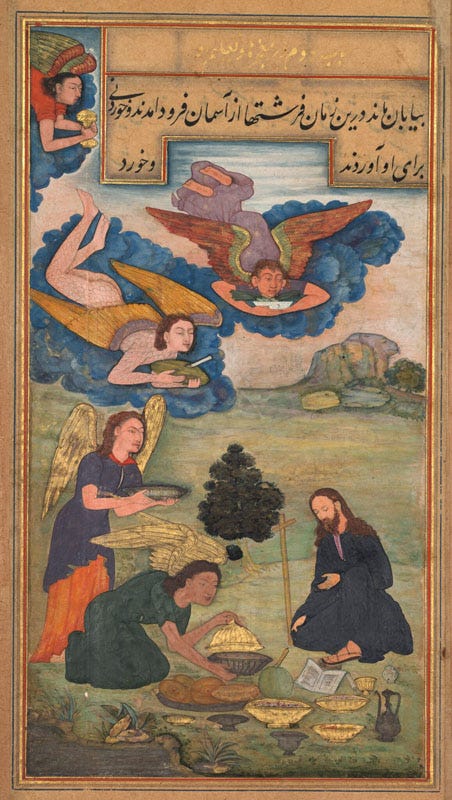
       Angels bring food to Jesus in the wilderness, by Muhammad Sharif (active ca. 1600)
                  From a Mir’at al-quds of Father Jerome Xavier (Spanish, 1549–1617).
       Episcopal preacher, Barbara Brown Taylor said: “Sooner or later, every one of us will get to take our own wilderness exam, our own trip to the desert to discover who we really are and what our lives are really about.”1

	Few of us will ever undergo an Outward Bound experience, or camp for an extended stay in the desert like Jesus. More likely, this wilderness experience happens when you or a loved one has a medical crisis. Or there's a death in the family, or a job lay off or car accident or a stroke. However the wilderness comes to us, it always strips us down to the bare essentials.

	Our first temptation is to want to flee the wilderness altogether. “I can’t stand this. Get me outta here!” But sometimes there is no way out.

	The wilderness forces us back onto our selves to see who we really are and what we’ve done with our lives and how we hurt (or helped) other people. There is no place to hide in the wilderness.  The desert sun is a like a spiritual spotlight which shines into all our dark hidden corners of our souls. The wilderness challenges us to see ourselves as we really are. It acts like a crucible that forces us to move from a "victim" mindset to a "survivor" or "victor" mindset. It is a place that strips away our reliance on external validation or comfort, and makes us confront our own limitations and power. The goal is to discover our inner strength and true identity.

	The church uses a special word for this kind of experience—it is called “be shriven”.  According to the Oxford English Dictionary (OED), the word shriven comes from the Old English word scrīfan, which originally meant "to decree" or "to prescribe" (linked to the Latin scribere, to write.) To be shriven means to confess your sins and then to receive penance and absolution. This is a very good way to begin Lent.

	The good news is that even though Jesus was driven into the desert, he stayed there, for forty days and forty nights, kept the faith, and stayed true to God and to himself. Jesus’ temptations were the same as most of our temptations—to try to fill that inner hole in our soul with anything but God. In the Jordanian desert, Jesus fully discovered who he belonged to—that he was a beloved son of God. He discovered his true Self, versus his false self and the clamoring needs of his ego.

	Brené Brown, in her book Braving the Wilderness, wrote, “Belonging so fully to yourself that you're willing to stand alone is a wilderness—an untamed, unpredictable place of solitude and searching. It is a place as dangerous as it is breathtaking, a place as sought after as it is feared. The wilderness can often feel unholy because we can't control it, or what people think about our choice of whether to venture into that vastness or not. But it turns out to be the place of true belonging, and it's the bravest and most sacred place you will ever stand.”2

	We meditate on Jesus’ experience in the desert to help us to face our own temptations when life throws us into some wilderness hell. He showed us that the key to resisting temptation is not settling for a quick fix but by finding within ourselves the key to our relationship with God.

	For instance, when Jesus hungered, he chose not to satisfy it simply with bread—wonderful, warm homemade bread, fresh from the oven dripping with butter and maybe even a little garlic. Jesus instead knew his real hunger was for the Word uttered by the Living God, which filled that deep hole inside him more satisfying than bread from the oven.

	The wilderness is both a hard teacher and a healer. If we happen to find ourselves in some wilderness, if we listen, we can learn a great deal, and be changed forever. The wilderness is one of the most reality-based, spirit-filled, life-changing places a person can be. And ultimately, this where we go when we want to be freed.

	Barbara Brown Taylor wrote: “What did that long, famishing stretch in the wilderness do to Jesus?  It freed him—from all devilish attempts to distract him from his true purpose, from hungry craving for things with no power to give him life, from any illusion he might have had that God would make his choices for him.  After forty days in the wilderness, Jesus had not only learned to manage his appetites; he had also learned to trust the Spirit that had led him there to lead him out again, with the kind of clarity and grit he could not have found anywhere else.”3

	So this Lent, I challenge myself and all of us dare to be shriven—to go into that special wilderness where God calls us to be deeply honest with ourselves, and to dare to be forgiven, liberated and freed.
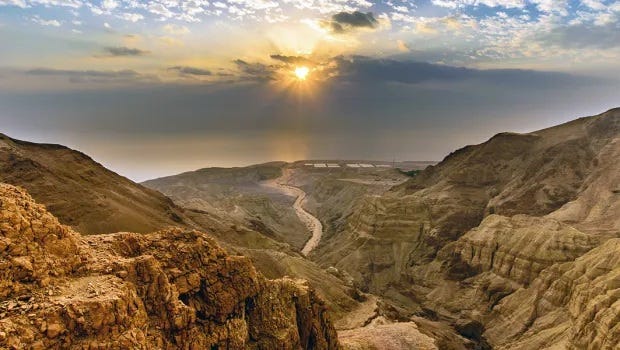
              Jesus spent 40 days in YeShimon, which means “Place of Desolation.”
The Judean Desert. Photo by John Theodor, Shutterstock.Inspirational Quotes
“The special courage it takes to experience true belonging is not just about braving the wilderness, it’s about becoming the wilderness. It’s about breaking down the walls, abandoning our ideological bunkers, and living from our wild heart rather than our weary hurt.”— Brené Brown, Braving the Wilderness: The Quest for True Belonging and the Courage to Stand Alone4

“Each entered the forest at a point he himself had chosen, where it was darkest and there was no path. If there was a path, it is someone else’s path and you are not on the adventure .”— Joseph Campbell, The Hero’s Journey 5

“You are only free when you realize you belong no place—you belong every place—no place at all. The price is high. The reward is great.” Maya Angelou, 1973 Interview with Bill Moyers.

“True belonging is the spiritual practice of believing in and belonging to yourself so deeply that you can share your most authentic self with the world and find sacredness in both being a part of something and standing alone in the wilderness. True belonging doesn’t require you to change who you are; it requires you to be who you are.”―Brené Brown, Braving the Wilderness: The Quest for True Belonging and the Courage to Stand Alone6
     In the Wilderness
     by Robert Graves7

Christ of His gentleness
Thirsting and hungering,
Walked in the wilderness;
Soft words of grace He spoke
Unto lost desert-folk
That listened wondering.
He heard the bitterns call
From ruined palace-wall,
Answered them brotherly.
He held communion
With the she-pelican
Of lonely piety.
Basilisk, cockatrice,
Flocked to his homilies,
With mail of dread device,
With monstrous barbéd slings,
With eager dragon-eyes;
Great rats on leather wings
And poor blind broken things,
Foul in their miseries.
And ever with Him went,
Of all His wanderings
Comrade, with ragged coat,
Gaunt ribs—poor innocent—
Bleeding foot, burning throat,
The guileless old scapegoat;
For forty nights and days
Followed in Jesus’ ways,
Sure guard behind Him kept,
Tears like a lover wept.

   The Olive Grove
   “Der Olivenhain”
 by Rainer Maria Rilke8

He went out under the grey leaves,
all grey and indistinct, this olive grove,
and buried his dusty face
in the dust of his hot hands.

It has come to this. Is this how it ends?
Must I continue when I'm going blind?
Why do you want me to say you exist
when I no longer find you myself?

I cannot find you any more. Not within me.
Not in others. Not in these stones.
I find you no longer. I am alone.

I am alone with everyone's sorrow,
the sorrow I tried to relieve through you,
you who do not exist. O unspeakable shame.
Later they would say an angel came.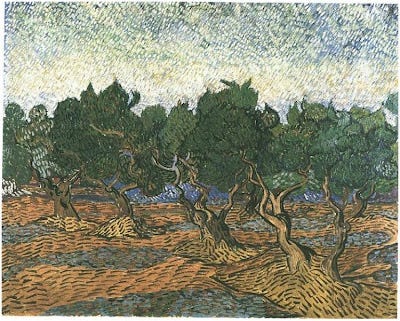
                                         The Olive Grove by Vincent Van Gogh,
                                      Saint-Rémy-de-Provence, France, November 1889.
    Command This Stone
  by Steve Garnaas-Holmes9

 “If you belong to God,  command this stone to become a loaf of bread.” —Luke 4.3

And then this boring meeting to become a circus,
this flabby body to become a work of art,
this life to become something else.

You can spend your life (oh, how we do)
inside a bubble of judgments and desires,
and never know even a simple stone.

No, stay here.
Let the stone be a stone,
the traffic be traffic.

Even this broken life,
this troubled soul,
this difficult time.

Otherwise how can a joy be joy,
a wonder a wonder?
Life is this, not something else.

This is the mystery of the fast,
the hungry day that is a hungry day,
free from the dictates of desire.

Nothing needs to be what it isn't.
There is glory enough in the stone.
And in you, already a child of God.

You can't command the transformation,
but only present yourself to God,
who can.

Just smile at Satan and say,
“No thanks.
I'm good.”
1 Barbara Brown Taylor, The Wilderness Exam, 1st Sunday of Lent - Year C,  Aired on: Sunday February 21, 2010.
2 Brené Brown, Braving the Wilderness: The Quest for True Belonging and the Courage to Stand Alone (New York: Penguin Random House, 2017) 4.
3 Barbara Brown Taylor, The Wilderness Exam, Ibid.
4 Brené Brown, Braving the Wilderness, Ibid., 37.
5 Joseph Campbell, The Hero’s Journey: the World of Joseph Campbell (New York: Harper Collins, 1990) iv.
6 Brené Brown, Braving the Wilderness, Ibid., 40.
7 Robert Graves, An Anthology of Modern Verse. Ed. A. Methuen. London: Methuen & Co., 1921.
8 Rainer Maria Rilke, A Year with Rilke: Readings from the prose, poems and letters of Rainer Maria Rilke, translated by Anita Barrows and Joanna Macy (New York: Harper One, 2009)
9 Steve Garnaas-Holmes, Unfolding Light – Poems (Sanford, Florida, Bookwifery, 2024) 45.
Powerful! What I needed to read. 🕊️